
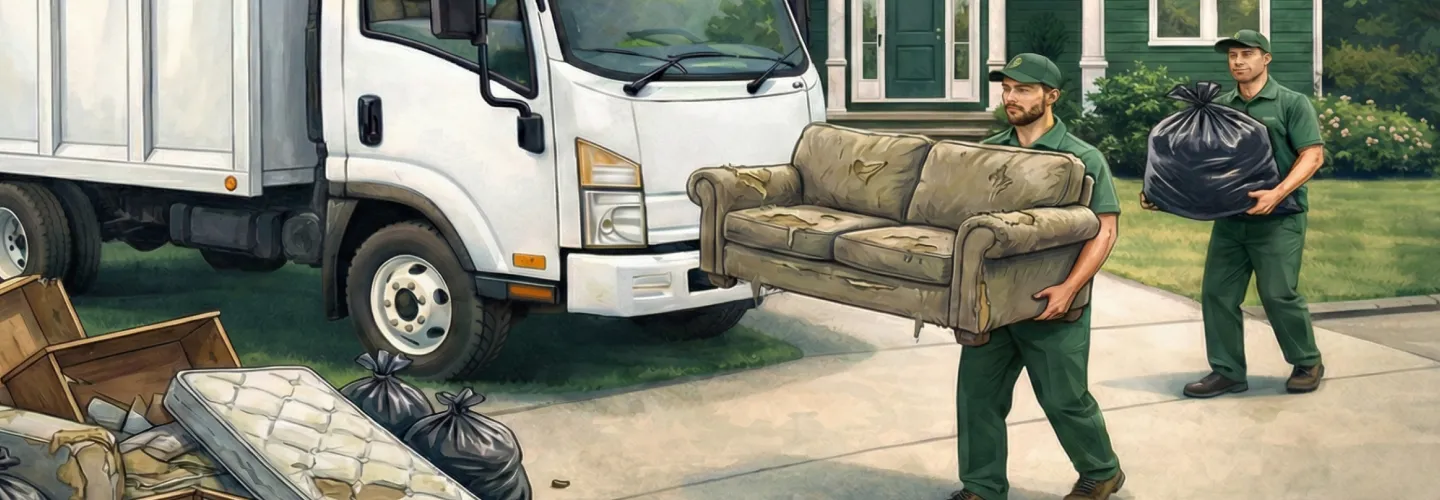
Suwanee Dumpster Rental Services
Choose our dumpster rental service for hassle-free delivery, flexible scheduling, and transparent pricing—making your cleanup or renovation project easier and more affordable than ever.
Get a Free QuoteOur Suwanee Junk Removal Services
Dumpster Rental in Suwanee, GA – Local Service Guide
Dumpster rental in Suwanee, GA is essential for managing waste from home projects, seasonal cleanouts, and commercial operations. In neighborhoods like Olde Towne and Suwanee Station, residents often need dumpsters for furniture or appliance replacement, especially during spring cleaning or after moving. Local disposal options include donation, recycling, or responsible landfill use, with logistics shaped by driveway access, weather, and item size. For residential spaces such as garages, basements, or yards, Suwanee’s tree coverage and storm cycles drive demand for yard waste and trash pickup, particularly after heavy rains or during fall leaf drop. Commercial clients in areas like Town Center and Peachtree Industrial frequently require dumpsters for office renovations, restaurant upgrades, or retail turnover, with needs varying by industry and volume. Specialty services—such as for estate cleanouts, construction debris, or hoarding—demand careful planning, coordination with property managers, and attention to local property contexts. For guidance on local rules and permits, visit the Suwanee Public Works Department.
Key Considerations for Dumpster Rental in Suwanee
- Timing your rental around seasonal cleanouts or project schedules
- Securing necessary permits for placement and disposal
- Choosing proper disposal channels (donate, recycle, landfill)
- Ensuring access for delivery and pickup in Suwanee neighborhoods
- Estimating the right volume for your project or business
- Coordinating with local guidelines for specialty or large-scale items
Benefits of Dumpster Rental in Suwanee
Fast Delivery and Pickup
Flexible Rental Periods
Wide Range of Dumpster Sizes
Transparent Upfront Pricing
Easy Online Booking
Reliable Local Service
Suwanee Right-of-Way Permit Requirements for Roll-Off Dumpster Placement on Public Streets
Placing a roll-off dumpster on any public street, sidewalk, or right-of-way in Suwanee requires advance coordination with the city's permitting authorities. The Suwanee Public Works Department oversees street maintenance and right-of-way management, and any container placed within the public right-of-way must comply with municipal access and safety standards. Key requirements include:
- Permit application: Submit requests through the city's planning and public works offices a minimum of 5–7 business days before the intended delivery date
- Prohibited locations: Dumpsters may not block fire hydrants, ADA-accessible ramps, mailboxes, or designated fire lanes
- Visibility and safety: Reflective tape or traffic cones may be required for containers placed on streets, particularly for overnight placement
- Duration limits: Permits for public right-of-way placement are typically issued for defined periods; extensions may require renewal
- Insurance documentation: A certificate of insurance may be required before approval is granted
Residents placing dumpsters on private driveways or yards generally do not need a city permit, though HOA rules may still apply. Contact Suwanee Code Enforcement to verify property-specific placement restrictions before scheduling delivery.
Suwanee Public Works Department
340 Town Center Avenue, Suwanee, GA 30024
Phone: (770) 945-8996
Official Website: Suwanee Public Works Department
Choosing the Right Dumpster Size for Your Suwanee Project: 10 to 40 Yard Guide
Selecting the appropriate container size is essential for avoiding overage fees and ensuring efficient waste removal. Dumpster capacities are measured in cubic yards, and each size is suited to specific project types. The following table outlines standard options:
Dumpster Size Comparison for Suwanee Projects
| Size | Dimensions (L×W×H) | Capacity | Weight Limit | Typical Projects | Pickup Loads Equivalent |
|---|---|---|---|---|---|
| 10 Yard | 12' × 8' × 3.5' | 10 cubic yards | 2–3 tons | Bathroom remodel, garage cleanout, small deck removal | 2–4 pickup trucks |
| 15 Yard | 16' × 8' × 4' | 15 cubic yards | 2–3 tons | Kitchen remodel, flooring removal, large cleanout | 4–6 pickup trucks |
| 20 Yard | 22' × 8' × 4.5' | 20 cubic yards | 2–4 tons | Roof tear-off, carpet removal, basement cleanout | 6–8 pickup trucks |
| 30 Yard | 22' × 8' × 6' | 30 cubic yards | 3–5 tons | Home addition, large renovation, multi-room demolition | 9–12 pickup trucks |
| 40 Yard | 22' × 8' × 8' | 40 cubic yards | 5–8 tons | New construction, commercial cleanout, whole-house demolition | 12–16 pickup trucks |
Important considerations for Suwanee residents and contractors:
- Heavy materials such as concrete, brick, and dirt are significantly denser than household debris; a 10–15 yard container is recommended to avoid exceeding weight limits
- Overage fees are typically charged per ton over the stated weight limit
- Mixed loads containing both light debris and heavy materials should be estimated conservatively
- Building permit projects in Suwanee may require an on-site waste management plan; verify with Suwanee Building Permits & Inspections
Suwanee Dumpster Placement Guidelines: Clearance, Surface, and Access Requirements
Successful dumpster delivery depends on adequate site preparation. Roll-off trucks require specific clearance and approach conditions to safely position containers. Before scheduling delivery, verify the following:
Pre-Delivery Placement Checklist for Suwanee
- Overhead clearance: Minimum 23 feet of clear height above the placement area; check for low-hanging power lines, tree branches, and garage door structures
- Access width: At least 10–12 feet of unobstructed width for the delivery truck to maneuver
- Approach length: A minimum 60-foot straight approach is needed for the truck to position the container (accounting for truck length, container length, and turning radius)
- Surface condition: Place containers on hard, level surfaces such as concrete or asphalt; avoid soft ground, grass, or unpaved areas where sinking may occur
- Driveway protection: Use ¾-inch plywood boards beneath the container when placing on asphalt driveways to prevent surface damage
- Fire code compliance: Maintain a minimum 5-foot clearance from all building structures; do not obstruct fire hydrants or emergency access routes
- Utility clearances: Ensure no obstructions near gas meters, water mains, or underground utility lines
Suwanee's tree canopy, particularly in established neighborhoods, may present overhead clearance challenges. The Georgia Tree Council provides resources on tree preservation, and residents should avoid trimming trees in the public right-of-way without city authorization. Contact Suwanee Planning Services & Zoning for guidance on placement near protected trees or within overlay districts.
Suwanee Building Permits & Inspections
340 Town Center Avenue, Suwanee, GA 30024
Phone: (770) 945-8996
Official Website: Suwanee Building Permits & Inspections
Georgia Landfill Restrictions and Prohibited Items for Suwanee Dumpster Rentals
Georgia's solid waste regulations, administered by the Georgia Environmental Protection Division (GA EPD), establish material restrictions that apply to all roll-off dumpster loads destined for permitted landfills. Suwanee residents and contractors must ensure that prohibited materials are separated and disposed of through appropriate channels. The following items are universally prohibited from rental dumpsters:
- Hazardous waste: Paints, solvents, pesticides, motor oil, antifreeze, and chemical cleaners
- Asbestos-containing materials: Require licensed abatement and separate disposal at approved facilities
- Freon-containing appliances: Refrigerators, freezers, and air conditioning units must have refrigerant recovered by an EPA Section 608-certified technician before disposal
- Medical and biohazardous waste: Sharps, pharmaceuticals, and biological materials require specialized handling
- Propane tanks and compressed gas cylinders: Explosion risk prohibits landfill disposal
- Lead-acid and lithium batteries: Must be recycled through designated programs; retail takeback is available at most auto parts stores
- Tires: Subject to separate disposal fees and recycling requirements under Georgia law
Contaminated loads—those containing prohibited items—may be refused at the landfill, resulting in additional hauling fees and potential code violations. Gwinnett County, which encompasses Suwanee, operates household hazardous waste collection events periodically for residents needing to dispose of restricted materials. The Suwanee Stormwater Management division also enforces pollution prevention measures to ensure dumpster contents do not contaminate local waterways during rain events.
Georgia Environmental Protection Division
2 Martin Luther King Jr. Drive SE, Suite 1456, Atlanta, GA 30334
Phone: (404) 656-4713
Official Website: Georgia Environmental Protection Division
Construction Debris Sorting and Stormwater Compliance for Suwanee Dumpster Use
Renovation and construction projects in Suwanee generate significant volumes of debris that require proper sorting and disposal. The Suwanee Building Permits & Inspections department may require a building permit for demolition or major renovation work, and waste management planning is often a component of the permitting process. Key material handling requirements include:
- Clean fill separation: Concrete, brick, asphalt, and soil should be separated from general construction debris, as many facilities accept clean fill at reduced rates or for recycling
- Scrap metal recovery: Steel, aluminum, copper, and other metals should be sorted for recycling rather than landfill disposal
- Wood waste: Untreated lumber may be accepted at wood recycling facilities; treated or painted wood requires standard landfill disposal
- Roofing materials: Asphalt shingles are recyclable at select facilities in the greater Atlanta metro area
- Drywall: Gypsum wallboard should be kept dry and separated where possible, as wet drywall generates hydrogen sulfide gas in landfills
Suwanee's stormwater management ordinances require that dumpsters on construction sites be managed to prevent sediment and debris from entering storm drains. Covering open containers during rain events and positioning dumpsters away from drainage pathways are standard compliance measures. Pre-1978 structures may contain lead-based paint, requiring adherence to the EPA Renovation, Repair, and Painting Rule during demolition.
Suwanee Code Enforcement
340 Town Center Avenue, Suwanee, GA 30024
Phone: (770) 945-8996
Official Website: Suwanee Code Enforcement
What Neighborhoods Do We Serve Throughout Suwanee, GA?
Dumpster rental services are available throughout Suwanee, with delivery logistics tailored to each neighborhood's access conditions and regulatory requirements:
- Suwanee Town Center: Mixed-use area near City Hall with narrower streets and higher pedestrian traffic. Right-of-way permits are typically required for street placement; off-peak delivery scheduling is recommended to minimize congestion.
- Shadowbrook: Established single-family residential community with mature tree canopy that may limit overhead clearance. Driveway placement is standard; plywood boards recommended for asphalt surface protection. HOA notification may be required.
- Suwanee Station: Newer planned community with wide streets and accessible cul-de-sacs accommodating 20–40 yard containers. HOA covenants may restrict placement duration and require advance written approval.
- McGinnis Ferry Road Corridor: Commercial and mixed-use zone with loading dock access available at some properties. Coordinate delivery timing with business operating hours; commercial waste hauler licensing may apply for long-term rentals.
- Olde Atlanta Club: Gated community with controlled access requiring advance coordination for delivery truck entry. Tree-lined streets and decorative landscaping necessitate careful site assessment for overhead and width clearance.
- George Pierce Park Area: Residential neighborhoods adjacent to parkland with proximity to environmentally sensitive areas. Stormwater compliance is particularly important; containers must be positioned away from drainage features and covered during rain events.
- Settles Bridge Road Area: Semi-rural properties with longer driveways and potentially unpaved surfaces. Site assessment recommended to evaluate ground conditions; plywood mats may be necessary to prevent container sinking on soft ground.